
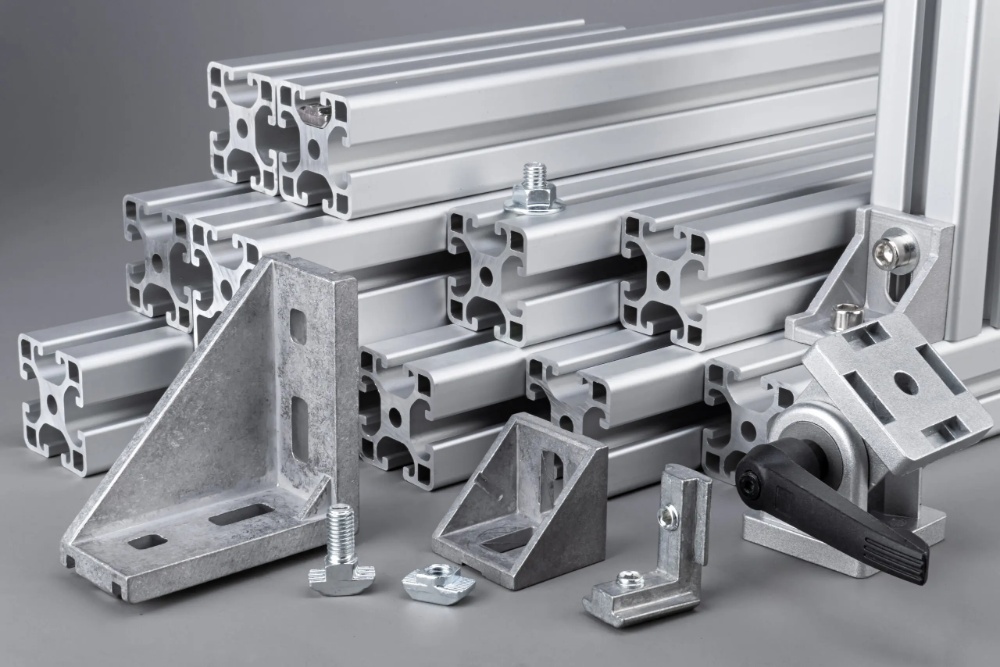
Flaws in aluminum extrusion usually start from uneven processes or varying materials. Surface issues like die lines, scratches, or blisters often come from bad die care or dirt on billet surfaces. Size errors happen when the metal flow in the die is not even, caused by shifts in temperature or die damage. Internal problems, such as voids or inclusions, stay hidden but can weaken the structure badly—especially in parts that hold weight, like window frames or industrial T-slot profiles.
Aluminum industrial profiles, industrial aluminum extrusions, and industrial aluminum alloy profiles are alloy materials with aluminum as the main component. Aluminum rods are melted and extruded to obtain aluminum materials with different cross-sectional shapes. However, the mechanical properties and application fields of the industrial aluminum profiles produced are different depending on the proportion of alloys added. If billet temperatures lack proper control or heating times vary, the metal flow turns rough inside the die space. This roughness creates uneven grain patterns and clear surface marks after the material cools. In the same way, weak lubrication between the billet and container walls boosts friction heat. That can lead to spot melting and blister growth.
How Do Extrusion Defects Affect Mechanical Strength and Machining Efficiency?
Extrusion flaws impact product function right away by lowering mechanical strength and harming size stability. Parts with surface issues need extra steps like polishing or re-anodizing to match the look standards. In bad cases, these marks raise scrap rates during quality checks.
When extruded profiles move to CNC machining steps—such as drilling, milling, or cutting—the existence of size differences speeds up tool damage and setup duration. Low-quality extruded materials often call for several hold adjustments in machining since their cross-sections stray from set limits. As a result, run times stretch out and output drops.
Xihui Aluminium delivers precision-customized CNC-machined aluminum profiles engineered for performance-critical industries, combining advanced CNC machining (±0.01 mm tolerances), aerospace-grade alloys (6061 and 7075), and end-to-end services—from rapid prototyping to surface finishing. This level of precision ensures that once extrusion quality is stabilized, CNC repeatability improves dramatically—reducing rework rates and enabling consistent, high-speed production.
How Does CNC Machining Precision Reinforce Quality Control in Aluminum Manufacturing?
The link between extrusion quality and CNC accuracy cannot be separated. If the extrusion step yields uneven shapes or leftover stresses in the profile, even a top-notch machine fails to reach the best results. Keeping steady extrusion settings thus stands as a basic need for hitting tiny-level accuracy in machining.
Which Factors Influence Dimensional Precision During CNC Processing?
Precision relies on several linked elements: machine setup sharpness, spindle firmness under pressure, cutting tool shapes fit for aluminum alloys like 6061-T6 or 6063-T5, plus tuned feed speeds and coolant-use plans. Fixture setup also matters a lot; bad holding boosts shake-caused shifts that twist small details on slim-walled parts.
Our high-precision custom CNC machining aluminum parts exemplify how integrated process optimization ensures ±0.01 mm tolerance across complex geometries while maintaining excellent surface finish through controlled feed speeds and multi-axis coordination.
How Can Extrusion Tolerances Be Synchronized with Machining Requirements?
To cut total errors between extrusion and machining phases, setting up tolerance matches proves key. We use digital tools for measuring that compare real extrusion results to planned CAD sizes before machining starts. This match stops excess cutting in milling tasks and makes sure final setups fit well in their planned spaces.
Feedback ties between extrusion workers and machinists boost steadiness further by allowing quick setting changes based on check data patterns. Our ISO 9001-certified processes ensure durable components with superior corrosion resistance and thermal conductivity. By linking statistical process control (SPC) systems into both extrusion presses and CNC centers, variation causes can be spotted soon, stopping expensive later fixes.
What Advanced Monitoring Technologies Improve Process Stability?
Current aluminum making leans more on sensor setups for instant tracking of heat changes, pressure swings, and size drifts across production paths. Machine learning tools review this info to foresee flaws before they happen. By adding predictive checks over both extrusion presses and machining spots, we keep process evenness even in big-batch work.
For instance, our custom aluminum extrusion machining parts utilize continuous monitoring systems that automatically adjust feed speeds according to thermal expansion feedback—ensuring consistent results across varying environmental conditions.
How Does Reducing Defects Translate into Cost Control Across Operations?
Each flaw adds direct costs via wasted material and indirect costs via late shipments or client upset. Fixing faulty extrusions uses more power while speeding up tool wear in repair machining tasks. Measuring these unseen costs shows how stopping flaws ties directly to profit gains.
What Strategies Effectively Lower Operational Costs Through Process Precision?
Setting standard billet-ready steps makes sure of even heat spread before pressing—a vital point for smooth metal movement in dies. Using exact tools made just for aluminum alloys cuts shavings in half and lengthens tool-use time. Ongoing worker training on flaw spotting cuts waste more by finding oddities early in work cycles.
What Technological Innovations Support Both Quality Assurance and Cost Efficiency?
Automation now stands as vital in handling modern extrusion lines. Auto die-switch setups cut wait time between runs, while robot arm systems avoid people-caused surface harm on new extruded pieces. These tools shorten wait periods without losing sharpness—a strong edge, especially useful in big building jobs needing even finishes over thousands of meters of profile length.
How Do Digital Twins Enhance CNC Optimization?
Digital twin tech lets virtual testing of machining routes before real runs begin. By guessing possible limit drifts under varied toolpath plans or spindle turns, experts can fine-tune setups without stopping lines. Virtual building also aids trial checks that weigh how small feed rate shifts might affect size wander over long tasks—a key skill for keeping repeat results across groups.
Why Is Data Integration Critical Across Manufacturing Stages?
Central data hubs link instant measures from extrusion presses with action records from CNC machines. This tie-up aids forecast upkeep planning based on real gear actions instead of set times—cutting surprise stops while stretching machine life. Instant reviews let managers make forward choices based on real proof rather than after-the-fact looks alone.
For clients seeking seamless coordination between design intent and manufacturing reality across global supply chains, our team remains available through our contact portal to provide tailored consultation on optimizing both cost efficiency and quality assurance within their aluminum component workflows. For more information, please contact us immediately!
FAQ
Q1: How do you ensure consistent quality across both extrusion and CNC processes?
A1: We maintain an integrated production system combining 15 extrusion lines with 40 CNC centers under unified SPC monitoring to ensure consistent dimensional accuracy throughout all manufacturing stages.
Q2: What materials are most suitable for precision aluminum machining?
A2: Alloys such as 6061 and 7075 offer excellent machinability coupled with high strength-to-weight ratios; they are ideal for aerospace-grade components requiring tight tolerances.
Q3: Can you accommodate low-volume custom orders without compromising lead time?
A: Yes, our flexible OEM & ODM model supports rapid prototyping within seven days using existing molds while guaranteeing full-scale repeatability once designs are finalized through collaborative validation sessions with clients’ engineering teams.